Showing posts with label Morrison area. Show all posts

Saturday, November 01, 2008

Time Travelling with Maggie Crow

That's what historians do, isn't it? I'm sure everyone has noticed how much these recent weeks are like other times in our nation's past. A couple of weeks ago, some of us attended History Night at nearby Indian Hills, and found ourselves victims of that cliché about history repeating itself. We also got some insight into how national events play out in the lives of so-called ordinary people.

First it was "John Parmalee," who came to Colorado from Iowa in 1860, after news of the gold strikes reached him as it did so many others. Portraying Parmalee, John Steinle, from Hiwan Homestead Museum, reminded us that the impetus to leave homes in the east was not just the lure of gold, but also a result of the financial crisis precipitated by bank failures in 1857.

Then it was my turn, as Maggie Maple Crow... in the early 1890s, Maggie and husband Will moved to Creede. In 1891, Creede had 10,000 people, most trying to make a living mining silver. Maggie and Will, accompanied by tiny daughter Dora, sewed tents for miners to live in, a profitable enterprise after fire in June 1892 destroyed many of Creede's more durable buildings. Creede was a wild town, with about a killing a day, Maggie later said. "One day as I left the tent with my little girl, Dora, a miscarried shot whizzed straight through the tent. We barely missed the bullet."

It was in Creede that Will Crow became acquainted with Bob Ford and did some carpentry work for him. In appreciation, Ford gave Will Crow the gun, a frontier model Colt 45, with which Ford had killed Jesse James in 1882. Ten years had passed, and Ford confided to Will that he was a little tired of killing; two weeks later Ford himself was killed by a member of the James gang. That's how Maggie tells the story. (She kept the gun, displaying it in a 1948 newspaper interview.)

In 1893, of course, history caught up with Creede and many other mining towns in Colorado when the Sherman Silver Purchase Act was repealed, and the bottom dropped out of the silver market. Almost overnight, Creede went from boom to bust as its people, including the Crow family, left in search of other lodes and means of survival. Maggie and Will ended up back home in Junction. Always looking for ways to sustain themselves and their growing family, they later worked in a lumber camp together.

The Roaring Twenties found Maggie, a widow, panning gold in Hall Valley with her sons while raising her grandchildren. (Dora had died in the influenza epidemic of 1918-19.) She panned out about $2-3 a day (not bad income in those days), with grandson Ray playing as a gold panner next to her. Prospecting also got her through next big Depression, in the 1930s, and supplemented her Old Age Pension ($24/month), which began arriving in 1935.

Read about Maggie's next 1890s adventure, in her own words, at HistoricMorrison.org.


——
Photo of history night courtesy Cheryl Touryan. Creede's population these days is about 377 people (per 2000 census).

More on: the Panic of 1857,
the Panic of 1893, and its causes;
Creede, the silver camp that wouldn't die,
and the Sherman Silver Purchase Act.


Wednesday, March 21, 2007

Back in the Day

Retrieving and researching historic aerial photos recently, I ran across this great 1955 view of what my neighborhood looked like before it was a neighborhood. (Post updated September 2008.)


There are a couple of drainages on the left, and one house upper right and a few others lower right. That's about it, unless you start thinking history. The lines that meet at the top center tell a fascinating story, one which I've barely started to explore. The "four track" that veers left and downward is an old wagon road, also reported as a cattle drive, most likely both. The single line that curves to the right around the hill is the visible remnant of an old flume that was intended to carry water from Bear Creek to the north to farms off far to the southeast. Perhaps it did for a time. In about 1910, there was also a 9-hole golf course in this area!

Here's a look at the approximate area over which our neighborhood was built. I'll put up the "after" shot soon. (Well, eventually.)


Explorations of the new (to me) field of ecological history are capturing my interest and attention lately. Repeated aerials are going to be a great way to find out more about this area, especially as "on-the-ground" traces of historic use can fade over time.

Much later, a 2008 update, here's the "after" view, taken in about 2002. New features dominate the old landscape. The small reservoir to the north was built in 1981. A new water pipeline, not yet revegetated, occupies part of the old wagon road. The land north of the dozen or so new houses (two more have been added since) is now part of Mt. Falcon Park, accessed by a new parking lot and visible trails. The old flume, subject of a new post, is more subtle now, fading into the background of this photo, but still easily traced on the ground. The land south of the road, at the lower edge of the picture, is a horse pasture subject to heavy grazing.


Overall, though, we've been lucky. As parkland, much of the area remains as it was more than 50 years ago.

Tuesday, April 04, 2006

Alice's Boots


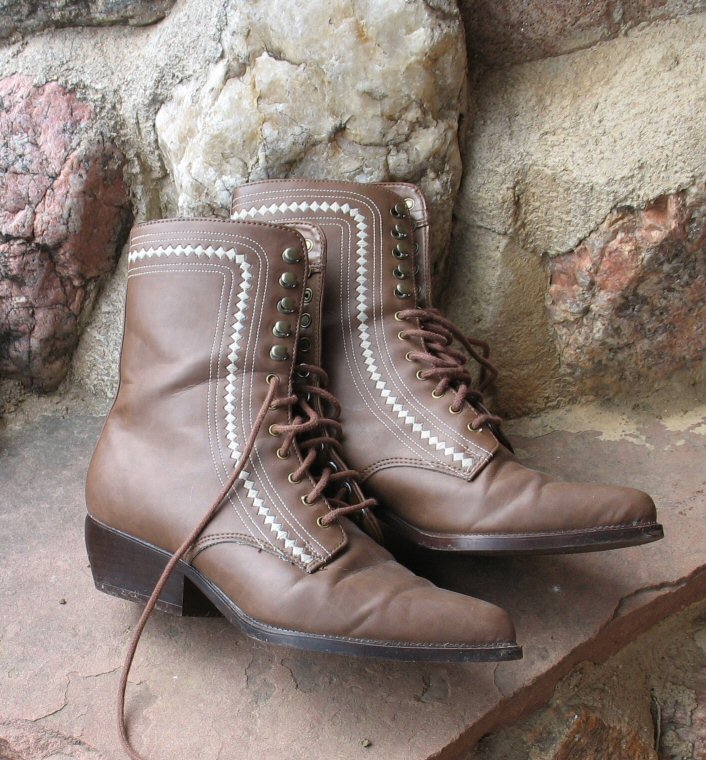
The day I first put on Alice’s Boots I wasn’t confident I could spend an entire day in them. Pointed-toed, high-laced shoes, with that undercut heel so important to the horsewoman— they looked like they just might become instruments of torture before a few hours at the office had passed. But it was the embroidery that sold me. Just a touch of femininity, for Alice was, in my mind, also a lady.

Alice Derby is going to be my new historic identity, so I’ve been looking into her life and times a bit. Of course, these aren’t really her boots, but as soon as Lila showed me this new acquisition, I coveted them for Alice. (Lila has a true flair for finding items at the thrift stores and turning them into costumes. She’s building up her already substantial collection in preparation for outfitting the whole town for this summer’s Centennial celebrations.)

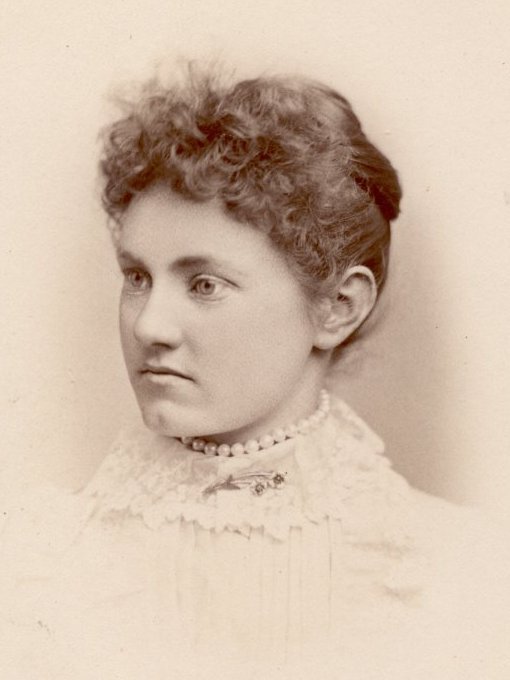
Born on the ranch in 1865, Alice was the second of Alexander and Emeline Rooney’s five children. I can imagine her childhood, growing up on the ranch, riding the hills, and taking care of little Emma Nora, her sister seven years younger. Alice and Nora are the center of a family legend, the only story I've heard of Alice, though usually her name (and Nora’s) are missing from the tale.

For a time, it looked like Alice was headed for spinsterhood, for she’d passed the age of thirty without marrying. Then she met Will Derby, apparently an older man, and they settled on their own ranch and raised a daughter, Eloise. By 1920, Alice was 55, probably a widow, approaching my own age. Now seventeen, Eloise had recently married young Gunnar Nelson and would soon begin delivering Alice’s grandchildren.

Alice's older brother, Otis, lived on the family ranch with his wife Christina and their four children. Two younger brothers, Charles and William, were long (and tragically) dead, as were her parents. (Alex and Eme, however, had died of more natural causes.) Alice’s sister Nora was raising her four young children not far away. Although Otis inherited the main ranch and its buildings, Alice and Nora had both shared in the division of the estate and were ladies of property, land which remained firmly in their own names after they married.

That's Rooney Ranch, 1920. It’s going to be fun filling in the stories of this family’s life—and learning new ones to share!

In 1920, Alice also had a ringside seat to some major moments in local history. So far, there is little or no record of her participation, a fact which leaves me mostly free to invent. Her personality and perspective are revealed in several family letters, soon to be shared by Alice’s great-grand-niece, which should help me reconstruct some of Alice’s true character.

Necessary facts aside, one of the greatest aids to the process will be learning to walk a mile in Alice's boots.